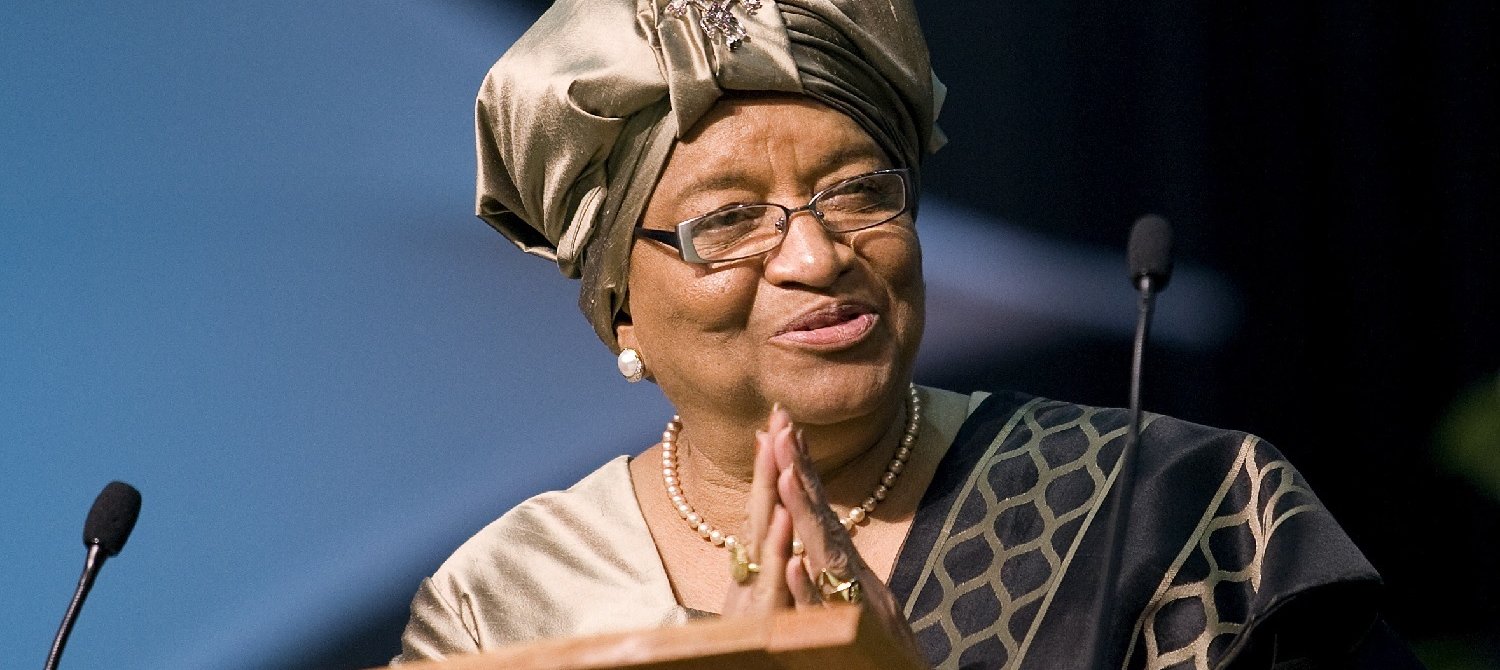
Ellen Johnson –Sirleaf, the first female President Sub-Saharan Africa. This week’s session featured a film which documented the first year of President Johnson-Sirleaf’s presidency and the challenges faced by her as she led the reconstruction of the state of Liberia during the immediate aftermath of the end of the civil war, navigating not only potential uprising from among citizens, but the precarious environment of Liberia’s split political elite.
A previous session explored service delivery, as a means of building citizen satisfaction with government performance and a consequent ability to create state legitimacy and stability. While my thoughts on this topic highlighted this correlation as potentially problematic due to, in particular, the fickle nature of citizen perceptions of government performance, I don’t think this changes the fact, as supported by a wealth of literature, that citizen satisfaction with government performance is an important aspect of the social contract and crucially for the purposes of this blog post, that perception is everything in this regard. For me, this session’s focus on the rise to power and early stages of Ellen Johnson Sirleaf’s presidency showcased her brilliant use of communication to build satisfaction and legitimacy among Liberians, not only for herself but also the state, which was crucial to re-stabilising the country at that point.
The session, focused on the mostly positive aspects, of Johnson-Sirleaf’s triumph in election and the earliest points of her presidency. This post reflects this focus, however I don’t necessarily mean to express an opinion on her overall leadership up to this point.
‘Old Ma’, the Smooth Operator
Looking at a couple of example, firstly she styled herself as a peacemaker, using the potential stumbling block of her womanhood in a highly male dominated sphere to her advantage. She did this by leveraging social norms in this instance- as put by Melinda Adams- catering to perceptions that women in Liberia have been peacemakers rather than those responsible for sparking the conflict- a norm echoed by Liberians during the film. Conveniently this was a picture also consistent with the image of the ‘old ma’, but it apparently wasn’t a worthless pursuit, as this had apparently helped her secure victory in the first place.
Furthermore, she appeared to understand that appearing relatable is one of the quickest ways to build affinity. When switching to broken English when talking to protesting ex-military men, I got the sense that her form of expression was important in communicating in a way that would not only be understandable to them, but in a way that would really resonate with or ‘hit’ them. This was particularly the case at a round table discussion with the leaders of some of the protestors when she explained that she had to be balanced in compensating the soldiers, because of the message that would send to the poor suffering in rural areas, in large part because of the actions of soldiers against them.
The persona gave the sense of someone being reprimanded on moral truths by a peace-making grandmother. In this way she stood down their demands, while, it seemed, sending a message that their voices had been heard. With a sort of peace during her rule and her subsequent re-election, one could suggest that her approach has paid at least some dividends.
The success to me was in the dexterity with which President Johnson-Sirleaf was able to navigate different political spaces and adapt completely adapt her comportment according to whom she was speaking. It’s a reality that seems self-evident when spelled out explicitly, but which seems much harder to do in practice. Though maintaining a strong demeanour throughout, ‘old ma’, the self-described mother to the people, was a completely different person to the astute, hard-ass, who read Firestone the riot act over their treatment of Liberian workers, or to the diplomat who addressed World Bank representatives and fellow heads of state in other countries.
I like to call politics a game. And in this game, Johnson-Sirleaf knew the rules and played them. She demonstrated that perception of the reality when engaging with the populace is as significant as reality. And she worked to carefully guide public perception of herself and her administration. In this way Johnson-Sirleaf was able to score political points without doing much. I found that to be, with a resource-scarce government in the context of politically-fragile post-conflict Liberia, nothing if not extremely shrewd.
Was she an Iron Lady? Maybe. But I don’t know that the task with which she was faced, could have been handled by anything but a firm, astute leader.
However, an adept political chameleon? From what I could see, I’d say absolutely.
Additional Sources
- Adams, M. (2008) Liberia’s Election of Ellen Johnson-Sirleaf and Women’s Executive Leadership in Africa, Politics & Gender, 4(3), 475-484
- Independent Lens, PBS (2008) Iron Ladies of Liberia’ discussion guide
- Kieh, G. K. (2009), The Roots of the second Liberian civil war, International Journal on World Peace 26(1)
 The Narrator's Pen